Product Type : Music
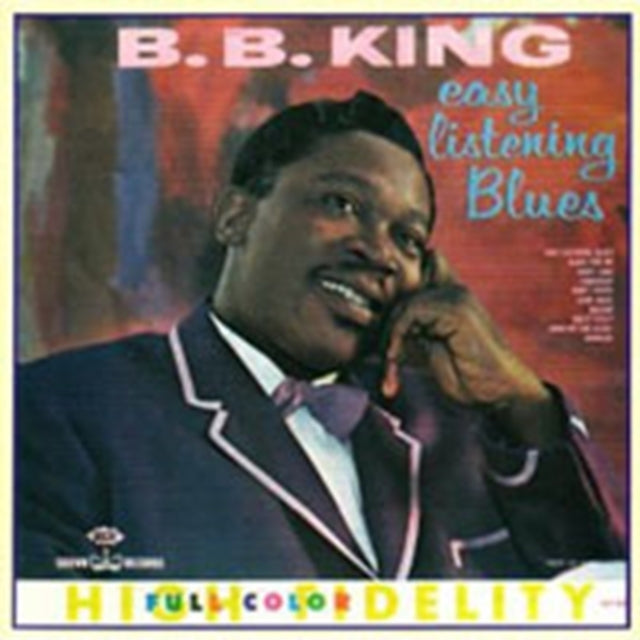
B.B. King - Easy Listening Blues (CD) (UK Import)
B.B. King - Easy Listening Blues (CD) (UK Import)
Artist: B.B. King
Music Genre: Blues
- Label
- Ace
- Cat No
- CDCHM 1011
- Released
- 2004
- Pressing
- UK
- Styles
- Chicago Blues, Electric Blues
 All items are imported on demand. Delivery to us normally takes 10 - 15 Working Days. Total delivery to your door in SA is 12 - 20 Working Days. Get it between &
Other formats & editions
Shipping Costs From R69 per order. Returns & Refunds Policy information click here
Couldn't load pickup availability
Details
| Artist | B.B. King |
|---|---|
| Format | CD |
| Label | Ace |
| Catalogue no. | CDCHM 1011 |
| Genre | Blues |
| Released | 5 July 2004 |
| Barcode | 0029667001724 |
B.B. King — Easy Listening Blues
Format: CD • Label: Ace (CDCHM 1011) • Released: 2004 • Pressing: UK • Genre: Chicago Blues, Electric Blues
Tracklist:
1. Easy Listening Blues Aka Easy Listening
2. Blues For Me
3. Night Long
4. Confessin'
5. Don't Touch
6. Slow Walk Aka Slow Burn
7. Walkin'
8. Hully Gully Twist Aka Hully Gully
9. Shoutin' The Blues
10. Rambler
11. Really The Blues Aka Slidin' And Glidin'
12. Low Rider
13. 3 O'Clock Stomp Aka Poontwangie
14. Mashing The Popeye
15. Mashing The Popeye Pt 2 Aka B.B. Rock
16. King's Rock Jazz
17. Talkin' The Blues
18. Boogie Rock Aka House Rocker
Imported from the UK.
About the artist
About the artist
King is one of the most influential blues musicians of all time, earning the nickname "The King of the Blues." He is considered one of the "Three Kings of the Blues Guitar" (along with Albert King and Freddie King, none of whom are related). Since he started recording in the 1940s, he released over fifty albums. He previously worked as a tractor driver.
In his youth, he played on street corners for dimes, and would sometimes play in as many as four towns a night. In 1947, he hitchhiked to Memphis, TN, to pursue his music career. In Memphis, B.B. stayed with his cousin Bukka White, one of the most celebrated blues performers of his time, who B.B. credits as one of his earliest mentors and teachers. King's first big break came in 1948 when he performed on Sonny Boy Williamson’s radio program on KWEM out of West Memphis. This radio performance led to steady engagements at the Sixteenth Avenue Grill in West Memphis and later to a ten-minute spot on the Memphis radio station WDIA. King's radio spot become so popular, it was expanded and became the “Sepia Swing Club.” As King worked at WDIA as a singer and disc jockey, he was given the catchy radio nickname "Beale Street Blues Boy", later shortened to "Blues Boy", and finally to "B.B."
In the late 1940s and early 1950s, King was a part of the blues scene on Beale Street. "Beale Street was where it all started for me", King said. He performed with Bobby Bland, Johnny Ace, and Earl Forest in a group known as The Beale Streeters. In 1949, King made his recording debut on Bullet (2) (Bullet Recording & Transcription Co.) by issuing the single "Miss Martha King", which did not chart well. Later that year, he began a recording contract with Los Angeles-based RPM Records (5). Many of King's early recordings were produced by Sam Phillips (who later founded Sun Record Company). King's recording contract was followed by tours across the US, with performances in big city theatres as well as gigs in small clubs and juke joints in the southern United States. During one show in Twist, Arkansas, a fight broke out between two men and caused a fire. King evacuated with the rest of the crowd, but realizing he left his acoustic guitar inside, rushed back inside the burning building to retrieve it. He later discovered the two men were fighting over a woman named Lucille. Ever since, each one of B.B.’s trademark Gibson guitars has been called Lucille, as a reminder not to fight over women or run into any more burning buildings.
In 1952, B.B. had a number one hit with “Three O’Clock Blues,” and began touring nationally soon after. 1956 became a record-breaking year, with 342 concerts booked and three recording sessions. That same year he founded his own record label, Blues Boys Kingdom, with headquarters at Beale Street in Memphis.
Source: Discogs