Product Type : Music
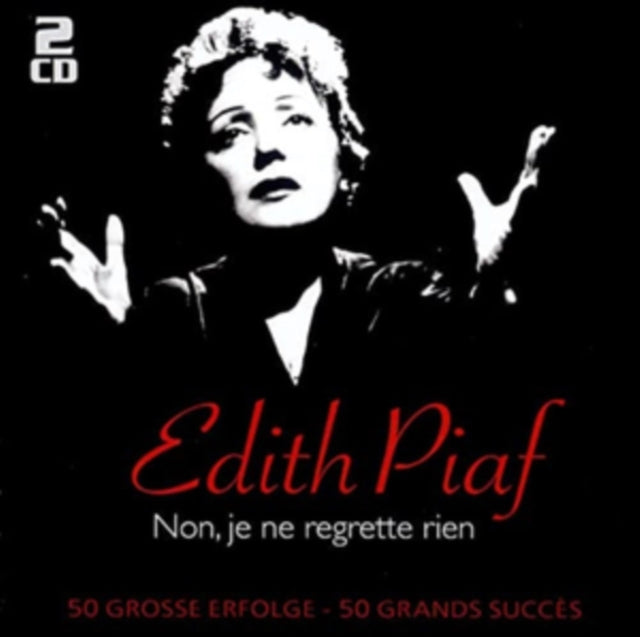
Edith Piaf - Non. Je Ne Regerette Rien - 50 Grosse Erfolge (CD) (UK Import)
Edith Piaf - Non. Je Ne Regerette Rien - 50 Grosse Erfolge (CD) (UK Import)
Artist: Edith Piaf
- Label
- Musictales
- Cat No
- 2087362
- Released
- 2015
- Pressing
- Germany
- Styles
- Chanson
EAN/UPC - 4260320873623
 All items are imported on demand. Delivery to us normally takes 10 - 15 Working Days. Total delivery to your door in SA is 12 - 20 Working Days. Get it between &
Regular price
R 419.00 ZAR
Regular price
Sale price
R 419.00 ZAR
Unit price
per
VAT included.
Shipping calculated at checkout.
Shipping Costs From R69 per order. Returns & Refunds Policy information click here
Couldn't load pickup availability
CD
Chanson and Pop
Edith Piaf — Non, Je Ne Regrette Rien (50 Grosse Erfolge - 50 Grands Succès)
Format: CD • Label: Musictales (2087362) • Released: 2015 • Pressing: Germany • Genre: Chanson
Tracklist:
1-1. Non, Je Ne Regrette Rien
1-2. Milord
1-3. Les Mots D'Amour
1-4. Mon Manège À Moi
Imported from the UK.
About the artist
About the artist
French singer and cultural icon born December 19, 1915, in Paris, and died October 11, 1963, in Plascassier.
Best known for singing songs , composed by Louiguy, with lyrics by Piaf, and English lyrics adapted by Mack David; and "Non, Je Ne Regrette Rien" written by Michel Vaucaire, which rather fittingly she sung just two years before the end of her eventful life.
In 1935 Piaf was discovered in the Pigalle area of Paris by nightclub owner Louis Leplée, whose club Le Gerny off the Champs-Élysées was frequented by the upper and lower classes alike. He persuaded her to sing despite her extreme nervousness, which, combined with her height of only 142 centimetres (4 ft 8 in), inspired him to give her the nickname that would stay with her for the rest of her life and serve as her stage name, La Môme Piaf (Parigot translatable as "The Waif Sparrow", "The Little Sparrow", or "Kid Sparrow"). Leplée taught her the basics of stage presence and told her to wear a black dress, later to become her trademark apparel. Leplée ran an intense publicity campaign leading up to her opening night, attracting the presence of many celebrities, including actor Maurice Chevalier. Her nightclub gigs led to her first two records produced that same year, with one of them penned by Marguerite Monnot, a collaborator throughout Piaf's life.
On 6 April 1936, Leplée was murdered, and Piaf was questioned and accused as an accessory but was acquitted. Leplée had been killed by mobsters with previous ties to Piaf. A barrage of negative media attention now threatened her career. To rehabilitate her image, she recruited Raymond Asso, with whom she would become romantically involved. He changed her stage name to "Édith Piaf", barred undesirable acquaintances from seeing her, and commissioned Monnot to write songs that reflected or alluded to Piaf's previous life on the streets.
In 1940, Édith co-starred in Jean Cocteau's successful one-act play "Le Bel Indifférent". She began forming friendships with prominent people, including Chevalier and poet Jacques Borgeat. She wrote the lyrics of many of her songs and collaborated with composers on the tunes. In 1944, she discovered Yves Montand in Paris, made him part of her act, and became his mentor and lover. Within a year, he became one of the most famous singers in France, and she broke off their relationship when he had become almost as popular as she was.
During this time, she was in great demand and very successful in Paris as France's most popular entertainer. After the war, she became known internationally, touring Europe, the United States, and South America. In Paris, she gave Atahualpa Yupanqui (Héctor Roberto Chavero) - the most important Argentine musician of folklore - the opportunity to share the scene, making his debut in July 1950. She helped launch the career of Charles Aznavour in the early 1950s, taking him on tour with her in France and the United States and recording some of his songs.
Source: Discogs