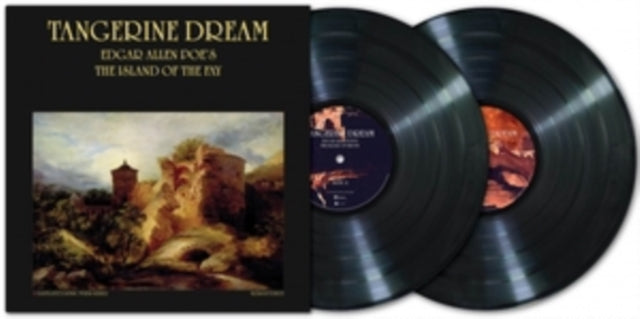
Product Type : Music
Tangerine Dream - Edgar Allan Poe's The Island Of The Fay (Etched D-Side) (Vinyl)
Tangerine Dream - Edgar Allan Poe's The Island Of The Fay (Etched D-Side) (Vinyl)
Artist: Tangerine Dream
Music Genre: Electronic
- Label
- Kscope
- Cat No
- KSCOPE1225
- Released
- 2024
- Pressing
- Germany
- Styles
- Berlin-School
EAN/UPC - 0802644822518
 All items are imported on demand. Delivery to us normally takes 10 - 15 Working Days. Total delivery to your door in SA is 12 - 20 Working Days. Get it between &
Shipping Costs From R69 per order. Returns & Refunds Policy information click here
Couldn't load pickup availability
Vinyl
Electronic
Tangerine Dream — Edgar Allan Poe's The Island Of The Fay
Format: Vinyl • Label: Kscope (KSCOPE1225) • Released: 2024 • Pressing: Germany • Genre: Berlin-School
Tracklist:
A1. Marmontel Riding On A Clef
A2. Breath Kissing Matter's Mouth
A3. Beauty Of Magic Antagonism
B1. Fay Bewitching The Moon
B2. Cycle Of Eternity
B3. Death In The Shadow
C1. Moment Of Floating Into The Light
C2. Darkness Veiling The Night
Imported from the UK.
About the artist
About the artist
Formed in Berlin in 1967, the initial line up (on their first release Electronic Meditation) included Edgar Froese, Conrad Schnitzler (cello) and Klaus Schulze (drums). Their compositions, or rather experimental improvisations, had roots in the psychedelia of London albeit with the "krautrock" twist. Both Schnitzler and Schulze would depart after Electronic Meditation, with the latter forming Ash Ra Tempel and going on to become the other major proponent of the Berlin School. Second album, Alpha Centauri, saw the addition of long-standing member Christopher Franke replacing Schulze, while Peter Baumann would come aboard for Zeit. The core of Froese, Franke and Baumann would sign to Virgin Records in 1973, and the subsequent release Phaedra would cement their style for years to come. Michael Hoenig temporarily replaced Baumann for an Australian tour in 1975. After Baumann's departure in 1978, TD experimented with the formula on Cyclone, which saw the addition of Steve Jolliffe, adding vocals and woodwinds and Klaus Krüger on drums.Johannes Schmölling would join for Tangram. This line-up remained stable until the mid-1980s. The increased emphasis on sequencers and rhythm in the first half of the 1980s divided fans, as did subsequent releases which veered heavily into relatively accessible, uplifting melodies.
After a brief stint with Jive Records from 1984 to 1988, TD signed to Baumann's Private Music label and then the equally New Agey Miramar, fully embracing digital textures and seeking to distance the group from its moody, psychedelic past. Paul Haslinger replaced Schmölling in 1985, and was in turn replaced by Froese's son Jerome Froese in 1990. Franke left in 1987 over creative differences with Froese. After a mid-1990s move to Edgar Froese's own TDI Music label (later renamed Eastgate), TD's reputation as a New Age band became less appropriate - father and son experimented with more modern sounds and revisited elements of past glories - but the group's artistic direction remained fairly entrenched in melodic pop-rock territory, with an increased use of acoustic instruments, particularly on stage.
Source: Discogs