Product Type : Music
Various Artists - Bedrich Smetana Collection (CD) (UK Import)
Various Artists - Bedrich Smetana Collection (CD) (UK Import)
Artist: Various Artists
Music Genre: Classic
- Label
- Brilliant Classics
- Cat No
- 96909
- Released
- 2023
- Pressing
- Europe
- Styles
- Romantic, Tone Poem, Overture, Dances, Symphony
 All items are imported on demand. Delivery to us normally takes 10 - 15 Working Days. Total delivery to your door in SA is 12 - 20 Working Days. Get it between &
Other formats & editions
Shipping Costs From R69 per order. Returns & Refunds Policy information click here
Couldn't load pickup availability
Details
| Artist | Various Artists |
|---|---|
| Format | CD |
| Label | Brilliant Classics |
| Catalogue no. | 96909 |
| Genre | Classic |
| Barcode | 5028421969091 |
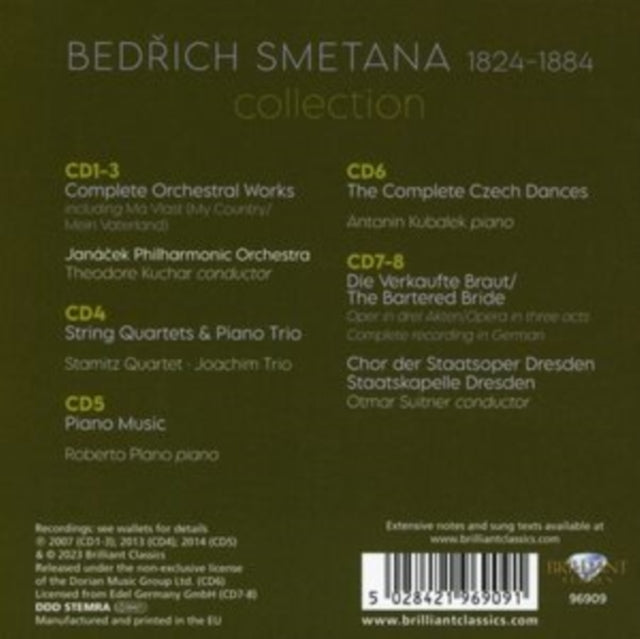
Bedřich Smetana — Collection
Format: CD • Label: Brilliant Classics (96909) • Released: 2023 • Pressing: Europe • Genre: Romantic, Tone Poem, Overture, Dances, Symphony
Tracklist:
1-1. Ma Vlast
1-2. Vltava (The Moldau)
1-3. Šarka
1-4. From Bohemia's Meadows And Forests
1-5. Tábor
1-6. Blanik
2-1. Wallenstein's Camp Symphonic Poem Op. 14
2-2. Hakon Jarl Symphonic Poem Op. 16
2-3. Richard III Symphonic Poem Op. 11
2-4. Overture To "The Bartered Bride"
2-5. Three Dances From "The Bartered Bride"
2-6. Furiant
2-7. Skocna (Dance Of The Comedians)
2-8. Doktor Faust Overture To The Puppet-Play By Matej Kopecky
2-9. Venkovanka The Peasant Woman, Polka
2-10. Nasim Devam To Our Girls, Polka
3-1. Festive Symphony In E Op. 6
3-2. Largo Maestoso
3-3. Scherzo, Allegro Vivace
3-4. Finale, Allegro Non Troppo Ma Energico
3-5. Festive Overture In C
3-6. Festive Overture In D Op. 4
3-7. Prague Carnival Introduction & Polonaise
3-8. March Of The National Guard
3-9. Shakespeare Festival March Op. 20
4-1. String Quartet No.1 In E Minor JB1:105 'From My Life'
4-2. II. Allegro Moderato A La Polka
4-3. III. Largo Sostenuto
4-4. IV. Vivace
4-5. String Quartet No.2 In D Minor JB1:124
4-6. II. Allegro Moderato
4-7. III. Allegro Non Più Moderato
4-8. IV. Finale: Presto
4-9. Piano Trio In G Minor Op. 15
4-10. II. Allegro, Ma Non Agitato
4-11. III. Finale: Presto
5-1. Andante In E Flat
5-2. Pensée Fugitive
5-3. Album Leaves Op. 2
5-4. Chanson: Moderato
5-5. Vivace
5-6. Allegro Commodo, Sempre Marcato
5-7. Moderato Con Anima
5-8. Andante Ma Non Troppo
5-9. Characteristic Pieces Op. 3
5-10. Wayfarer's Song
5-11. 'It Boils And It Roars'
5-12. Sketches Op. 4
5-13. Idyll
5-14. Memory
5-15. Persisten Endeavor
5-16. Sketches Op. 5
5-17. Melancholy
5-18. Friendly Landscape
5-19. Rhapsody
5-20. Album Leaves
5-21. Allegro In B Minor
5-22. Toccatina
5-23. Album Leaf In G - Trio (From Album Leaf In G Minor)
5-24. Lento In E-flat Minor
5-25. Con Moto In B-flat Minor
5-26. For Katerina Kolarova - Moderato
5-27. For Elisabeth F. Thun - Allegro
5-28. For Josephine Finke - Agitato
5-29. For Jean Kunz - Allegro
5-30. For Václav Ulwer - Grave
5-31. For Marie Proksch - Moderato
5-32. Andante In F Minor
5-33. Romance In G Minor
6-1. Book 1
6-2. Polka In A Minor
6-3. Polka In F
6-4. Polka In B-flat
6-5. Book 2
6-6. Slepicka (Little Hen)
6-7. Oves (Grain Dance)
6-8. Medved (Bear Dance)
6-9. Cibulicka (Little Onion)
6-10. Dupák (Stomping Dance)
6-11. Hulán (Lancer)
6-12. Obkrocák (Stepping Dance)
6-13. Sousedská (Neighbour's Dance)
6-14. Skocná (Hop Dance)
7-1. Die Verkaufte Braut = The Bartered Bride
7-2 - 7-14. Act I
7-15 - 7-19. Act II Beginning
8-1 - 8-6. Act II Continuation
8-7 - 8-30. Act III
Imported from the UK.
About the artist
About the artist
Smetana was the son of a brewer in Litomyšl in Bohemia, then part of the Austrian Empire. He studied piano and violin from an early age, and played in an amateur string quartet with other members of his family. Smetana attended a high school in Pilsen from 1840-1843. He studied music in Prague, despite initial resistance from his father. He secured a post as music master to a noble family, and in 1848 received funds from Franz Liszt to establish his own music school.
September 1855 marked the death of his second child, his beloved four-year-old daughter Bedřiška. When his third child died nine months later, he committed himself to composition, producing the Piano Trio in G minor. This piece is full of sadness and despair, making use of phrases that are cut short, possibly in resemblance to his daughter's own life.
In 1856, Smetana moved to Gothenburg, Sweden, where he taught, conducted and gave chamber music recitals. In 1863, back in Prague, he opened a new school of music dedicated to promoting specifically Czech music. By 1874 he had become deaf from syphilis, but he continued to compose; Má vlast was written after his deafness had developed. Smetana also suffered from tinnitus, which caused him to hear a continuous, maddening high note which he described as the "shrill whistle of a first inversion chord of A-flat in the highest register of the piccolo".
From 1875 he lived in small village of Jabkenice.
His string quartet in E minor, Z mého života (From My Life, composed in 1876), the first of only two quartets, is an autobiographical work. The final movement is punctuated by a piercing high E in the first violin which, Smetana explained, represents the devastating effects of his tinnitus. He may also be hinting at this personal misfortune with the piccolo scoring in Má vlast. In 1883 Smetana, due to further progressive neurological effects of his illness, became insane, and was taken to a mental hospital in Prague, where he died the following year. He is interred in the Vyšehrad cemetery in Prague.
Smetana was the first composer to write music that was specifically Czech in character. Many of his operas are based on Czech themes and myths, the best known being the comedy The Bartered Bride (1866). He used many Czech dance rhythms and his melodies sometimes resemble folk songs. He was a great influence on Antonín Dvořák, who similarly used Czech themes in his works.
Source: Discogs